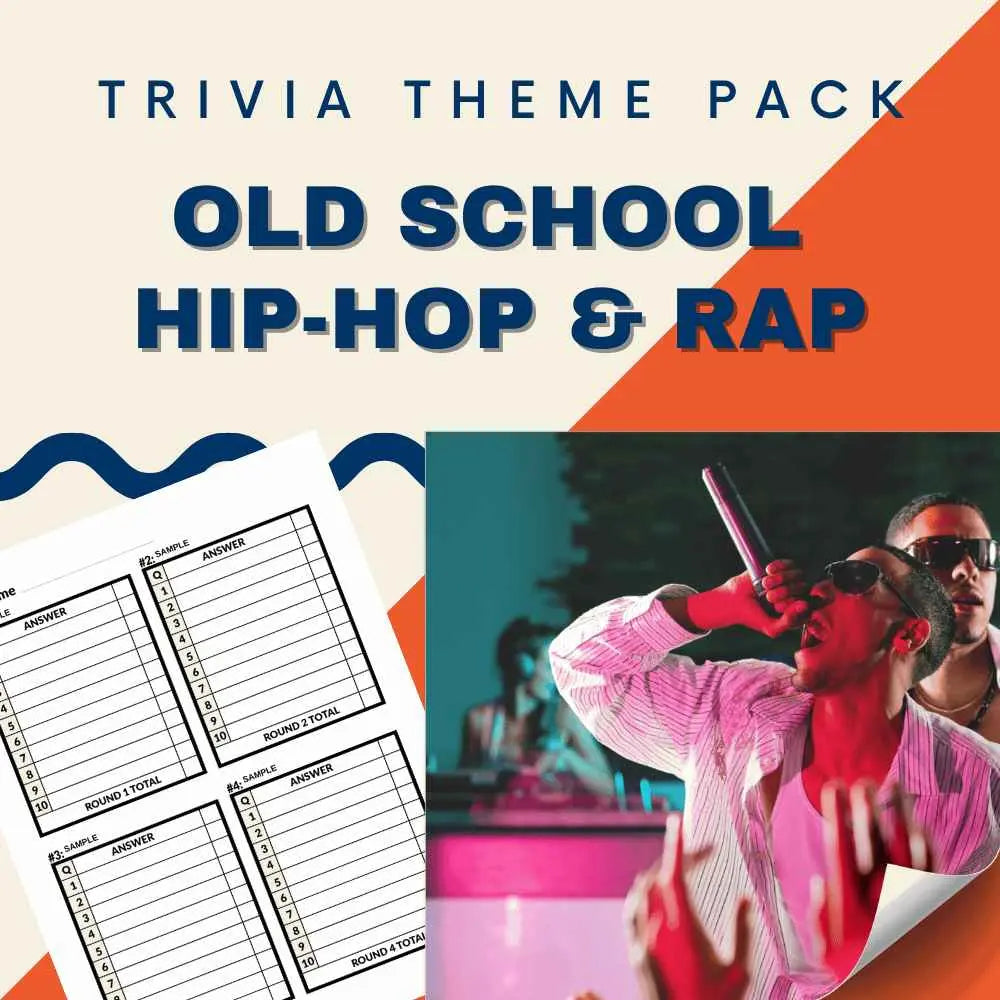
Old School Trivia, Hip-Hop & Rap Trivia Night Theme Pack
Old School Trivia, Hip-Hop & Rap Trivia Night Theme Pack
Couldn't load pickup availability
FREEWORLDWIDE
SHIPPING
100%SECURED
PAYMENT
The ultimate Hip-Hop & Rap trivia pack for rap music fans. 75+ carefully crafted hip-hop trivia questions — covering old school pioneers, Golden Age legends, and modern icons — every era, every crew, and every iconic track. Perfect for rap music trivia nights, old school hip-hop quiz, and themed game night events.
Perfect for: hip-hop fan meetups, music-themed pub trivia, rap-history events.
Hip-hop trivia turns the bar into a culture conversation — the kind of night where regulars argue about Biggie vs. Pac and end up buying another round. 75+ questions across the Bronx pioneers, Def Jam dynasty, West Coast G-funk, Southern bounce, and the modern era — written for rooms that know their stuff.
What's Inside
- 4 rounds of mixed-difficulty questions — 75+ total
- Themed picture round with high-res classic album covers and artist photos
- Host script — read and run, no experience needed
- PDF + PowerPoint formats included
- Commercial license for your venue built-in
- Instant download — host tonight
About Old School Hip-Hop & Rap Trivia
Hip-hop trivia is the music theme that fills the room with the 30-and-up crowd that grew up on cassettes, Yo! MTV Raps, and The Source magazine. The genre's commonly accepted birthday is August 11, 1973, when DJ Kool Herc threw his sister Cindy's back-to-school party at 1520 Sedgwick Avenue in the Bronx and pioneered the breakbeat technique that became the foundation of hip-hop. The first commercially successful rap single was The Sugarhill Gang's "Rapper's Delight" in 1979. Run-DMC's 1986 collaboration with Aerosmith on "Walk This Way" broke hip-hop into mainstream MTV rotation. The Golden Age — roughly 1986 to 1996 — produced the records that still dominate hip-hop trivia night: It Takes a Nation of Millions to Hold Us Back (Public Enemy, 1988), Straight Outta Compton (N.W.A, 1988), The Chronic (Dr. Dre, 1992), Illmatic (Nas, 1994), Ready to Die (The Notorious B.I.G., 1994), Reasonable Doubt (Jay-Z, 1996), and All Eyez on Me (2Pac, 1996).
The deep canon offers endless material: the four pillars of hip-hop (DJing, MCing, breakdancing, graffiti) coined by Afrika Bambaataa; the East Coast vs. West Coast feud and the 1996-1997 murders of 2Pac and Biggie; the Wu-Tang Clan's nine original members and Staten Island origins; Dr. Dre's protege chain (Snoop Dogg, Eminem, 50 Cent, Kendrick Lamar); Public Enemy's Hank Shocklee and the Bomb Squad production team; the Native Tongues collective (De La Soul, A Tribe Called Quest, Jungle Brothers); the Roxanne Wars; the Bridge Wars between KRS-One and MC Shan; the Source magazine's 5-mic ratings; and the producer pantheon — RZA, DJ Premier, Pete Rock, J Dilla, and Madlib. Bonus territory: hip-hop in film (Wild Style, Krush Groove, Boyz n the Hood, 8 Mile), the founding of Def Jam by Russell Simmons and Rick Rubin in 1984, and the No Limit and Cash Money empires that built the South.
Sample Hip-Hop Trivia Questions & Answers
What date is widely recognized as the birthday of hip-hop?
August 11, 1973. DJ Kool Herc threw a back-to-school party for his sister Cindy at 1520 Sedgwick Avenue in the Bronx, where his breakbeat technique laid the foundation for hip-hop.
What was the first rap single to achieve major commercial success?
"Rapper's Delight" by The Sugarhill Gang, released in 1979. It reached the Top 40 on the Billboard Hot 100 and introduced rap music to mainstream audiences worldwide.
Which hip-hop group's 1988 album It Takes a Nation of Millions to Hold Us Back is widely considered one of the greatest rap albums ever made?
Public Enemy. The album, produced by The Bomb Squad, featured tracks like "Don't Believe the Hype," "Bring the Noise," and "Rebel Without a Pause."
Who founded Def Jam Recordings in 1984?
Russell Simmons and Rick Rubin. The label launched the careers of LL Cool J, Run-DMC, Beastie Boys, and Public Enemy, becoming the most influential hip-hop label of the 1980s.
Which two rappers were murdered in 1996 and 1997 during the East Coast vs. West Coast feud?
2Pac (September 13, 1996, in Las Vegas) and The Notorious B.I.G. (March 9, 1997, in Los Angeles). Both murders remain officially unsolved.
What 1986 collaboration between a rap group and a rock band brought hip-hop into mainstream MTV rotation?
Run-DMC and Aerosmith's remake of "Walk This Way." The track became the first rap song to reach the top 5 of the Billboard Hot 100.
How many original members were in the Wu-Tang Clan?
Nine. RZA, GZA, Method Man, Raekwon, Ghostface Killah, Inspectah Deck, U-God, Masta Killa, and Ol' Dirty Bastard. They formed in Staten Island, New York in 1992.
What was Nas's debut album, considered one of the greatest hip-hop albums of all time?
Illmatic, released April 19, 1994. The 10-track album featured production from DJ Premier, Pete Rock, Q-Tip, Large Professor, and L.E.S.
What are the four pillars of hip-hop, as defined by Afrika Bambaataa?
DJing, MCing (rapping), breakdancing (b-boying), and graffiti writing. Bambaataa later added a fifth pillar: knowledge.
Which Dr. Dre protege released his debut album Doggystyle in 1993?
Snoop Doggy Dogg (now Snoop Dogg). The album was produced almost entirely by Dr. Dre and debuted at number one on the Billboard 200.
What hip-hop magazine introduced the famous "5 mic" album rating system?
The Source. Founded in 1988, the magazine's 5-mic rating became the most prestigious recognition in hip-hop journalism.
Who produced Eminem's breakout single "My Name Is" in 1999?
Dr. Dre. The track appeared on Eminem's major-label debut The Slim Shady LP, which won the Grammy for Best Rap Album.
What was Jay-Z's debut studio album, released in 1996?
Reasonable Doubt. Released on his own label Roc-A-Fella Records, it included the singles "Ain't No Nigga," "Can't Knock the Hustle," and "Dead Presidents II."
Which rap collective included De La Soul, A Tribe Called Quest, and the Jungle Brothers?
The Native Tongues. The collective was known for jazz-influenced production, positive lyrical themes, and Afrocentric imagery throughout the late 1980s and early 1990s.
How to Host a Hip-Hop Trivia Night
Hip-hop trivia draws music nerds, regulars who came of age in the 1990s, and the crews who still argue about who had the best Verzuz. Schedule on a weeknight — Wednesday or Thursday — and promote it three weeks out with classic-era album covers as your social media graphic. The 30-45 demographic spends more on drinks per head than any other group; this theme pulls them in.
Run four rounds of roughly 10 questions: an old school round (1973-1985), a Golden Age round (1986-1996), a 2000s and modern round, and a final round of producer credits, samples, and deep cuts. The picture round should feature classic album covers (Illmatic, The Chronic, Ready to Die, Enter the Wu-Tang) with artist names blacked out. Cap teams at 6. Charge $5 per team to play. Add a "name that beat" audio round if your venue has decent speakers — 30-second clips of iconic instrumentals.
Themed prizes elevate the night. First place gets a $50 venue gift card plus a vinyl record (a classic LP works great); second place gets a Wu-Tang or N.W.A t-shirt; last place gets a Soulja Boy crown or a deliberately corny prize. DJ a 90s hip-hop playlist between rounds. Run drink specials named after albums — a "Doggystyle" gin and juice, a "Chronic" green margarita, an "Illmatic" Hennessy cocktail. Wrap up by 10 PM. The crew that wins comes back next month.
Frequently Asked Questions
How many hip-hop trivia questions are in this pack?
The pack contains 75+ hip-hop trivia questions split across four rounds covering old school, Golden Age, 2000s, and modern eras, plus a themed picture round with classic album cover imagery. That's enough material for a full 90-minute trivia night.
Does this cover only old school or modern hip-hop too?
Both. The pack is weighted toward old school and Golden Age (1973-1996), but includes a full round on 2000s and modern hip-hop so younger fans can compete. The era split is clearly labeled in the host script.
What format does the hip-hop trivia pack come in?
You receive both a printable PDF and a PowerPoint file. Print the PDF for team answer sheets and project the PowerPoint on a TV or screen for the picture round. Both files are sent to your inbox within minutes of checkout.
Can I use this hip-hop trivia pack at my bar or restaurant?
Yes. A commercial license is built into every Cheap Trivia pack. You can run it at your bar, restaurant, brewery, country club, hotel, or any private venue you operate, as many times as you want.
Are the questions clean enough for a family-friendly venue?
The questions themselves are written professionally and don't include explicit lyrics or language. However, hip-hop's history includes mature themes — the Notorious B.I.G., 2Pac, N.W.A. If your venue is strictly family-friendly, screen the host script first.
Run Music Trivia Every Week
One hip-hop pack runs once. The Cheap Trivia Weekly Subscription sends a fresh, professionally-written trivia pack to your inbox every Sunday — perfect for venues running weekly trivia year-round. First month is $1.
Delivery
Instant digital delivery. Check your email within minutes of checkout. Works on any device — no software to install. Need help? Contact us here and a real human replies within hours.